July 2, 2025

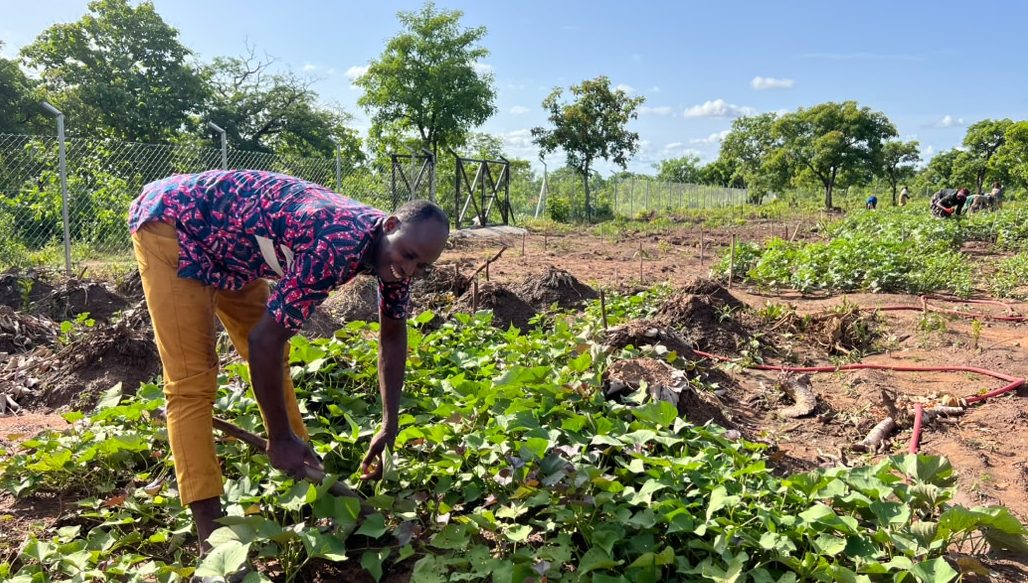
Photo: Margret (centre), a community agricultural extension volunteer, training women farmers.
In many rural communities across Africa, farming is the foundation of daily life and survival. Yet for generations, agricultural training and advisory roles – called “extension services” and typically offered by government ministries of agriculture or by community volunteers trained by them – have been critical to boosting productivity and ensuring food security. But they have largely been dominated by men.
For women farmers, who often bear the burden of household food production and work as unpaid labourers on their husbands’ farms, this gap can mean missed opportunities, outdated practices, and restricted access to essential farming inputs.
That’s why the work of women like Margret in Uganda and Rita in Ghana is transformative. As agricultural extension agents, they do more than teach farming techniques – they shift gender dynamics, foster resilience, support climate change adaptation, and put life-changing knowledge directly into the hands of women.
Margret: A Farmer, Leader, and Lifeline in Eastern Uganda
Margret is a farmer, a mother of four, and a community agricultural extension volunteer with Kinvia’s long-time local partner in the area, the Uganda Community Based Association for Women and Children’s Welfare (UCOBAC). Her journey began when UCOBAC sought women who were not only involved in farming but also confident enough to speak in public.
Since I had both qualities, I volunteered and then UCOBAC started to train us. I had basic knowledge about farming and this partly enabled me to learn faster.
Margret’s role is to educate farmers on modern agronomic practices like pest and disease control, planting techniques, composting, pesticide application, and post-harvest handling. She works with five organized farmer groups with more than 100 farmers in total.

Plant clinics, which Margret helps organize, are the cornerstone of her work. She says the lessons she offers through the plant clinics are season-dependent: "We meet at the beginning, in the middle, and at the end of every season… to learn about the best farming practices that we need to do during that time of the season. Farmers have learnt the different ways to control pests and diseases, spraying with pesticides, good crop spacing, and how to make and use natural fertilizers and many more."
Margret has witnessed a clear impact. "Farmers have adopted modern agronomic practices like spray[ing] their crops on time and in the right way. This has reduced the spread of pests and diseases… and farmers are also yielding bigger harvests."
For Margret, the most fulfilling part is sharing knowledge and best practices.”“ But the work also changes lives beyond the fields. “Today farmers have food in their homes,” she says. “My dream is that farmers practice farming on a large scale for both domestic and market consumption.” She also sees the possibility of a direct impact on the well-being of women: “I hope that farmers, especially women, develop economically [and that] separation, divorce, and domestic violence, which results from poverty, will be reduced.”
Rita: A Voice for Gender Equity for Ghana’s Farm Families
Over 4,000 kilometres away in northern Ghana’s Baare community, Rita is on a similar mission. A trained Agricultural Extension Agent (AEA) with the Ministry of Food and Agriculture (MoFA), she is also a proud native of the community and a mother of three. Rita grew up farming with her parents and turned that love for agriculture into a profession.
I just love to see and be with animals and seeing crops grow pleases me. Farming and agricultural-related work provided the means to our family’s livelihood.
Under the Sustainable Development, Human Rights, Inclusion, and Equality (SHINE) Project, supported by Kinvia and implemented locally through local partner RAINS, Rita plays a central role in helping women farmers build productive livelihoods. As an officer for Women in Agricultural Development (WIAD), she supports women with technical training on topics like row planting, fertilizer application, water management, and the cultivation of orange-flesh sweet potatoes, a vitamin-rich crop promoted for nutrition.

Rita’s gender-responsive approach is intentional and tailored. “I’m aware that women are not enjoying equal opportunities as men… I am intentional in visiting female smallholder farmers and their fields are always my priority.” She consults with women through their Village Savings and Loans Associations (VSLAs) and other farmer-based groups to schedule visits at times that work for them, which is critical in contexts where women are responsible not only for farm work but also for almost all domestic household and caregiving duties.
Rita also works to amplify women’s voices by communicating their specific and unique challenges to “higher authorities and sponsors” in MoFA Rita explains. Thanks to her advocacy, women farmers in her district have received start-up support for soya utilization, beehives for honey production, and land access through local initiatives.
One success story from the SHINE project involved demonstration plots, where women farmers tested out improved farming techniques like row planting and timely weeding. “They testified that the demonstration fields were doing better… Subsequent visits to their farms indicated that they had improved yields compared to the former.”
Why Women Supporting Women Matters
Both Margret and Rita underscore an important fact: women extension agents can reach and inspire women farmers in ways that male agents often cannot.
Women in rural farming communities face distinct social and cultural barriers to accessing training, resources, and markets. These challenges are often compounded by caregiving responsibilities, lower literacy levels, and limited land ownership. A woman extension agent brings not only technical knowledge but also relatability, trust, and an understanding of these unique dynamics.
These, in combination with gender equality training that is a standard practice within Kinvia’s large-scale agricultural projects, are shifting the power dynamics in communities in Ghana, Uganda and Ethiopia where Kinvia operates.
Margret’s work, for example, has increased women’s confidence and independence in Uganda. “I hope that farmers most especially women will develop economically,” she says, adding they will become less dependent on men for what they need to support themselves and their households.
In Ghana, Rita’s work helps close the gender gap in access to agricultural services, while also encouraging collaborative household decision-making. “I also educate the men and women on gender-related issues and the need for them to work together to build the families.”
When women farmers thrive, families eat better, children stay in school, and communities become more resilient to climate and economic shocks. As communities in Uganda, Ghana, and beyond work toward more inclusive and sustainable food systems, investing in women agricultural extension agents like Rita and Margret is not just a good practice, it’s a vital strategy to make health and prosperity available to all.
WANT TO LEARN MORE?
- Your support makes projects like these possible. Donate today to help support more community-led projects that improve education and food security.
- Beyond the Harvest: Growing Sustainable Futures in Northern Ghana
- A Legacy of Leadership: How Communities in Ethiopia Are Growing a Future Together
- Give a Legacy Gift. Leaving a legacy gift in your Will shapes a better tomorrow, offering essential support for future generations to flourish.