August 25, 2026
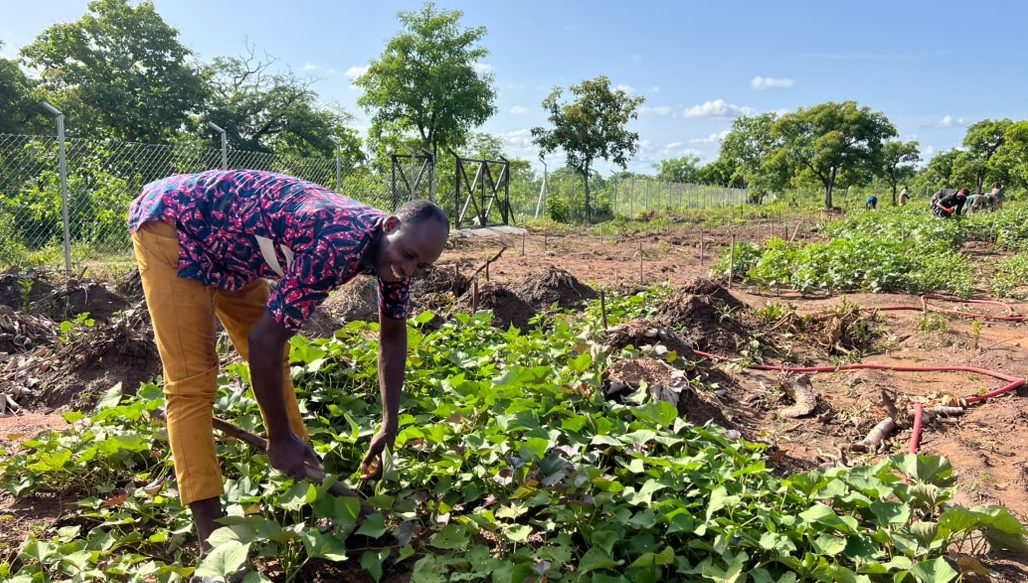
Photo: Ghana
Roughly one-third of young people in Ghana are classified as NEET — not in employment, education, or training — a reality reflected in many of the communities Kinvia supports.
Youth in this situation face heightened risks of social exclusion, long-term unemployment, poor mental health, and persistent economic insecurity. At the community level, high rates of youth disengagement are associated with lower productivity, reduced local revenues, increased pressure on social services, and greater social instability.
Yakubu, a 24-year-old from Kulinkpegu, was among them. “Life was difficult for me,” he says. He did not have the opportunity to attend school as a child and instead followed his parents and older siblings to their fields. As an adult, he grew maize and soybeans, but his harvests often fell short of what he needed.
For young people like Yakubu, making a good livelihood from farming in northern Ghana is further complicated by increasingly unpredictable rainfall, depleted soils, and limited access to productive crops and markets.
Without training in modern agronomic practices, Yakubu was finding it difficult to earn enough to support his young family and build a secure future.
In 2025, Yakubu joined an initiative that supported 130 youth with training and inputs to cultivate orange-fleshed sweet potato (OFSP) and cassava for both household consumption and income generation.
The opportunity brought light and hope to a situation that was growing increasingly bleak for Yakubu and his family.

I was idle not out of indolence but out of a lack of options for employment. Now, I see light and feel hope. I have a farm, and I am able to feed my children breakfast before they go to school.
Through the project, Yakubu was connected with agricultural extension agents and nutrition officers who provided practical training in everything from preparing land to retain water and planting vines at the right spacing to pest management and proper storage of crops. He even learned ways to incorporate sweet potato leaves and tubers into family meals.
Switching to OFSP made an immediate difference. Not only are sweet potatoes more suited to the drier, less nutrient-rich soils of northern Ghana, but they mature earlier, produce a better yield, and are more easily marketed than soybeans.
Yakubu harvested 12 bags, kept half for his family, and sold the rest. It was the start of a newfound interest in farming that soon expanded.
With support of the project’s agricultural extension agents, he learned how to build on his early success and turn his first successful harvest into something more.
With some of the proceeds, Yakubu bought a goat. Ten months later, that one goat had produced three offspring, giving him a herd of four.
He had enough income from his harvest to help pay university tuition for his nephew and began saving through a Village Savings and Loan Association.
Alongside increased family income, Yakubu’s OSFP crop has changed the nutritional quality of his family’s diet. The orange-fleshed sweet potato is rich in Vitamin A — particularly important in northern Ghana, where Vitamin A deficiency and other forms of malnutrition remain significant public health concerns.
Before the training, Yakubu didn't know the plant's leaves could be used in tea, soups, and stews. Now his family eats both the leaves and the sweet potatoes, and he intentionally incorporates them into family meals because of what he learned about their nutritional value.
One change has given him particular pleasure. For his children, eating sweet potato was a new experience that they embraced. Yakubu says “There were days they carried some cooked potato to school to share with their friends. I found that joyful.”
And what Yakubu has gained isn't limited to his own farm and family. He now has skills that he is sharing with other farmers, coaching them in good agricultural practices and OFSP production.
His plans are growing along with his harvest. He intends to continue cultivating orange-fleshed sweet potato alongside other crops, grow his goat herd, and continue to save through the VSLA.

I want to approach farming as a means to end poverty and food insecurity in my family and community in general.
For Yakubu, a once-precarious livelihood as a farmer in northern Ghana has turned into something solid he can build on — a source of food and income today, and a way to create greater security for his family in the years ahead.
WANT TO LEARN MORE AND HELP FAMILIES BUILD GREATER SECURITY?
- 🌱 Learn more about how farmers around the world build more resilient livelihoods despite the challenges of a changing climate.
- 📖 Learn why community-led Solutions Matter Now More Than Ever
- 🧡 Give today to help strengthen sustainable solutions for communities around the world